

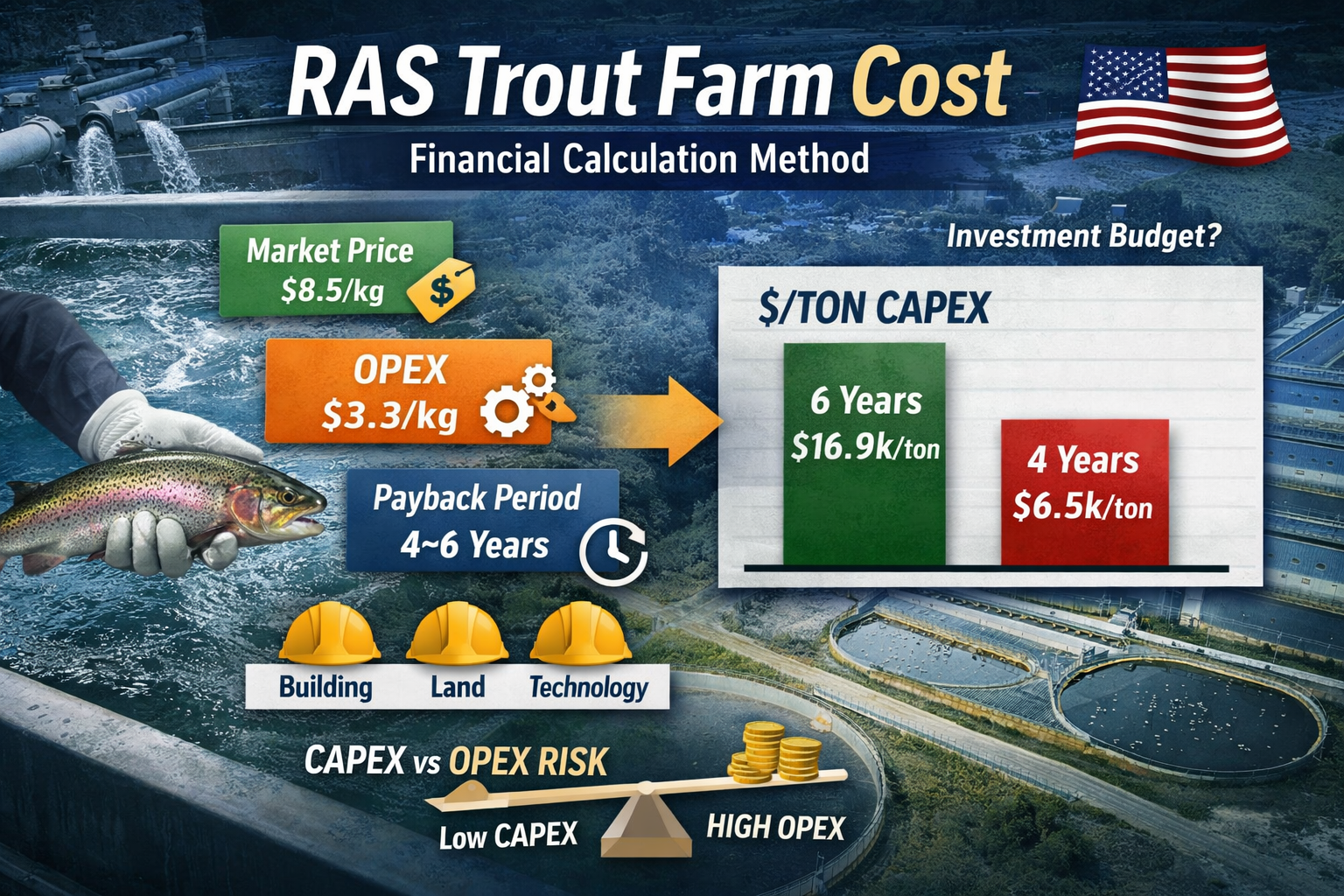
This article presents a practical methodology for calculating the cost of a RAS fish farm based on real economic drivers.
The example uses a trout farm with a market size of 350 g (0.77 lb) in the US wholesale market.
The purpose is not to provide exact project costs, but to define:
This approach can be applied to any species, country, or production model.
This analysis applies to land-based recirculating aquaculture system (RAS) projects.
CAPEX in RAS is not a fixed number — it is a function of price, OPEX and target payback.
Feed cost:
FCR × feed price
→ 1.1 × 1.8 = $2.0/kg
Assuming feed = 60% (50…70%) of OPEX:
OPEX = feed cost / 0.6
→ $2.0 / 0.6 ≈ $3.3/kg
→ ≈ $1.50/lb
Margin = price – OPEX
→ 8.5 – 3.3 = $5.2/kg
→ $2.36/lb
Annual profit:
→ $5,200 per ton
Allowable CAPEX = annual profit × payback
This model can also be used to estimate RAS cost per kg and evaluate overall fish farm CAPEX based on real production and market conditions.
Area ratio:
→ 10 m² per ton/year
→ 107.6 ft² per ton
Construction cost:
→ $900/m² ($83.6/ft²)
Result:
→ $9,000/ton
(including civil design)
Land area:
→ 20 m²/ton (2× building)
Land price:
→ $100/m²
Result:
→ $2,000/ton
First-year OPEX:
→ $3,300/ton
6-year payback, base scenario
→ $16,900/ton
4-year payback, optimized CAPEX
→ $6,500/ton
Technology CAPEX includes:
From an investment perspective, this approach reflects the real aquaculture investment cost and helps define a feasible budget range before starting detailed engineering.
Lower CAPEX always comes with higher OPEX risk.
Reducing investment typically leads to:
As a result, real payback may increase.
In practice, this simplified model can be used as a first step of a RAS feasibility study, allowing investors to quickly assess project viability before moving into detailed design.
The correct question is not:
“How much does a RAS farm cost?”
But:
“What level of investment is justified for this product, market and payback target?”
If you are planning a RAS project, we provide:
We support full project development, including feasibility studies and cost of aquaculture system evaluation for commercial RAS facilities.
If you are planning a RAS fish farm, the next step is to validate your assumptions.
This includes CAPEX, OPEX and production parameters before investment.


