
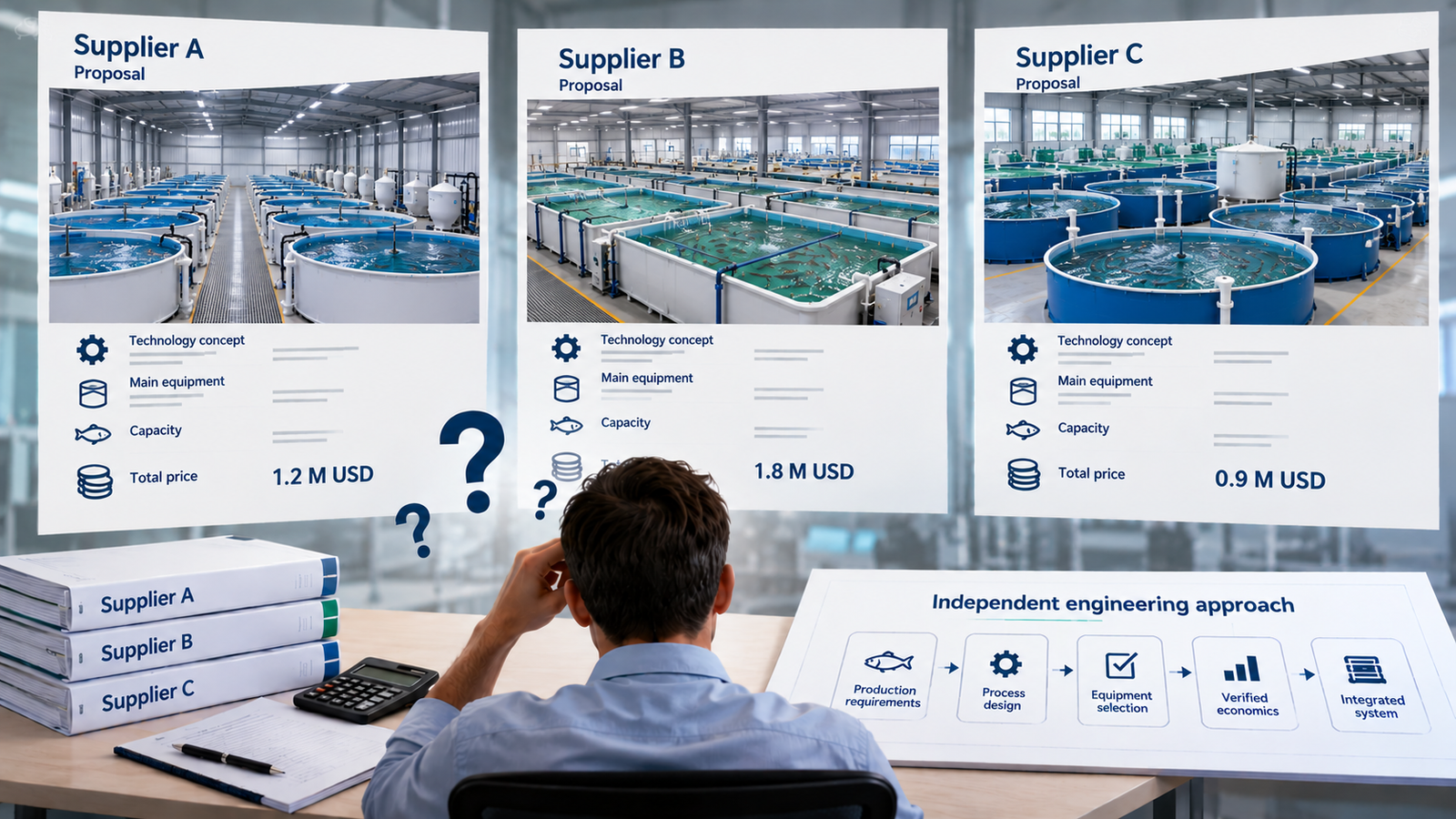
You send the same production requirements to three RAS suppliers — and receive three completely different proposals.
Different prices. Different biofilter sizes. Different drum filters, pumps, oxygenation and degassing systems. Sometimes even the process design itself is different.
If they are designing the same fish farm, why are the solutions so different — and which one do you actually need?
Equipment manufacturers know their products extremely well. That is their expertise.
The difficulty begins when the equipment portfolio also becomes the starting point for designing the entire farm.
One supplier may specialize in mechanical filtration. Another may favour a particular biofiltration technology. Another may build the system around equipment it routinely manufactures or supplies.
Every individual component may be perfectly good.
But good equipment does not automatically create a good RAS.
A recirculating aquaculture system is a chain of interconnected processes. The design of one treatment stage affects the requirements and performance of the next.
That makes it difficult to compare proposals simply by looking at equipment lists and total price.
Independent RAS design works in the opposite direction:
Fish → Production model → Loads → Processes → Required performance → Equipment → Supplier.
First, the production model defines maximum biomass, peak feed load, water-quality requirements, temperature and operating conditions.
Then we determine what each process actually needs to accomplish:
Only after the required performance of each process has been calculated should RAS equipment selection begin.
Not before.
A larger drum filter, pump or biofilter may provide a justified safety margin.
But that margin needs an engineering basis.
Unnecessary oversizing increases CAPEX, energy consumption and operating costs. At the opposite extreme, an attractive low-cost proposal may result from undersized treatment stages, insufficient redundancy or equipment and services excluded from the supplier’s scope.
The important question is therefore not:
“Which proposal is cheaper?”
It is:
“Why does my farm require this capacity?”
For every major component, the engineering logic should be traceable:
Design input → Process load → Required capacity → Equipment selection.
If that relationship is unclear, comparing prices alone can be misleading.
Different manufacturers have different strengths.
One may produce excellent drum filters. Another may offer better pumps. Others may specialize in oxygenation, degassing, UV treatment or automation.
There is no engineering reason why every component must carry the same logo if equipment from several proven manufacturers creates a better system.
This is where an independent RAS consultant adds value.
The objective is not to select a preferred brand. It is to select equipment that best meets the required process performance while considering reliability, proven operating experience, energy consumption, service, spare parts, CAPEX and lifecycle cost.
Vendor independence does not mean avoiding manufacturers.
A good RAS design consultant needs strong relationships with equipment manufacturers and a detailed understanding of available technologies.
Independence means something simpler:
First determine what the project needs. Then determine who should supply it.
If you have received several proposals with significantly different technologies, capacities and prices, an independent RAS design review can put them onto the same engineering basis.
The review can examine:
Only then are you truly comparing suppliers rather than comparing different interpretations of the same project.
Aquaculture Engineer starts with the production process — not an equipment catalogue.
We calculate the required treatment processes first and then select suitable equipment from proven manufacturers based on technical performance, reliability and project economics.
Our calculations and equipment specifications have a transparent engineering basis and can be independently reviewed.
Process first. Equipment second.
If you already have several RAS supplier proposals and cannot understand why their technologies, capacities and prices are so different, we can provide an independent RAS design review and determine what your project actually needs.
If you have received different technical and commercial proposals and are unsure which solution is properly sized, technically complete and economically justified, we can provide an independent engineering review.
Send the species, target capacity and site location. Dmitry Yakovlev, PhD, will review your inputs and suggest the next step: feasibility study, CAPEX/OPEX estimate or engineering design.
Initial project review — free of charge.


